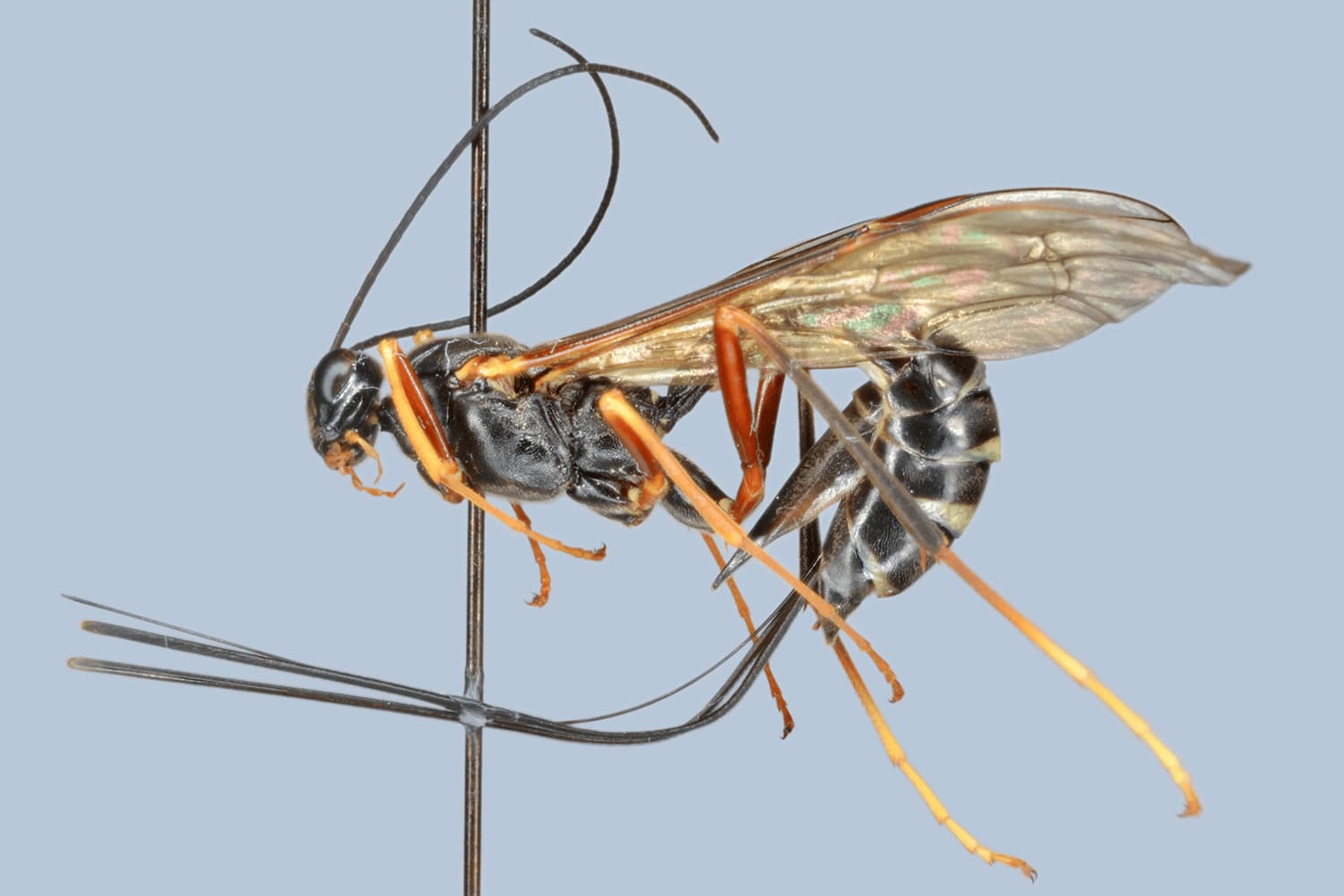
Coleocentrus excitator
Description
Acaenitinae is a small subfamily of medium to large sized Ichneumonids. Females are in all genera except
Leptacoenites
and
Procinetus
(none of which occur in northern Europe) easily recognized by the unusually long and pointed hypopygium which sometimes begin almost at the middle of the metasoma. Males are significantly more difficult to recognize but some useful characters include: clypeus often with a median tooth; the labrum often widely exposed; hind wing with nervellus intercepted above the center; fore and mid claws sometimes with subapical tooth; hind coxae and trochanters usually quite long; propodeum rather flat (without distinct dorsal and posterior slopes); ovipositor long and without notch. While universal characters are rare, most species are readily recognized as Acaenitines by their general shape.
Biology
Saproxylic beetles make up the vast majority of host records. However, there are also documented instances of rearing from xylophagous Hymenoptera and Lepidoptera, although the credibility of these reports varies. The lifecycles of Acaenitines are often poorly understood, but at least one species is known to be a koinobiont endoparasitoid.
Distribution
Many species are likely threatened or extinct in northern Europe. Only about half of the reported species have recent records, and several of those are single isolated finds in diminishing environments. Since most species are large and easily recognized it is unlikely that they would remain unnoticed for extended periods of time. Two species,
Coleocentrus excitator
and
Phaenolobus terebrator
, listed as LC and NT respectively in Finland, seem to be doing well.
Acaenitinae has a near cosmopolitan distribution.
Identification
A key to northern European species is provided here. For a traditional key, see Zwakhals (1989) or Medvedev (1981).