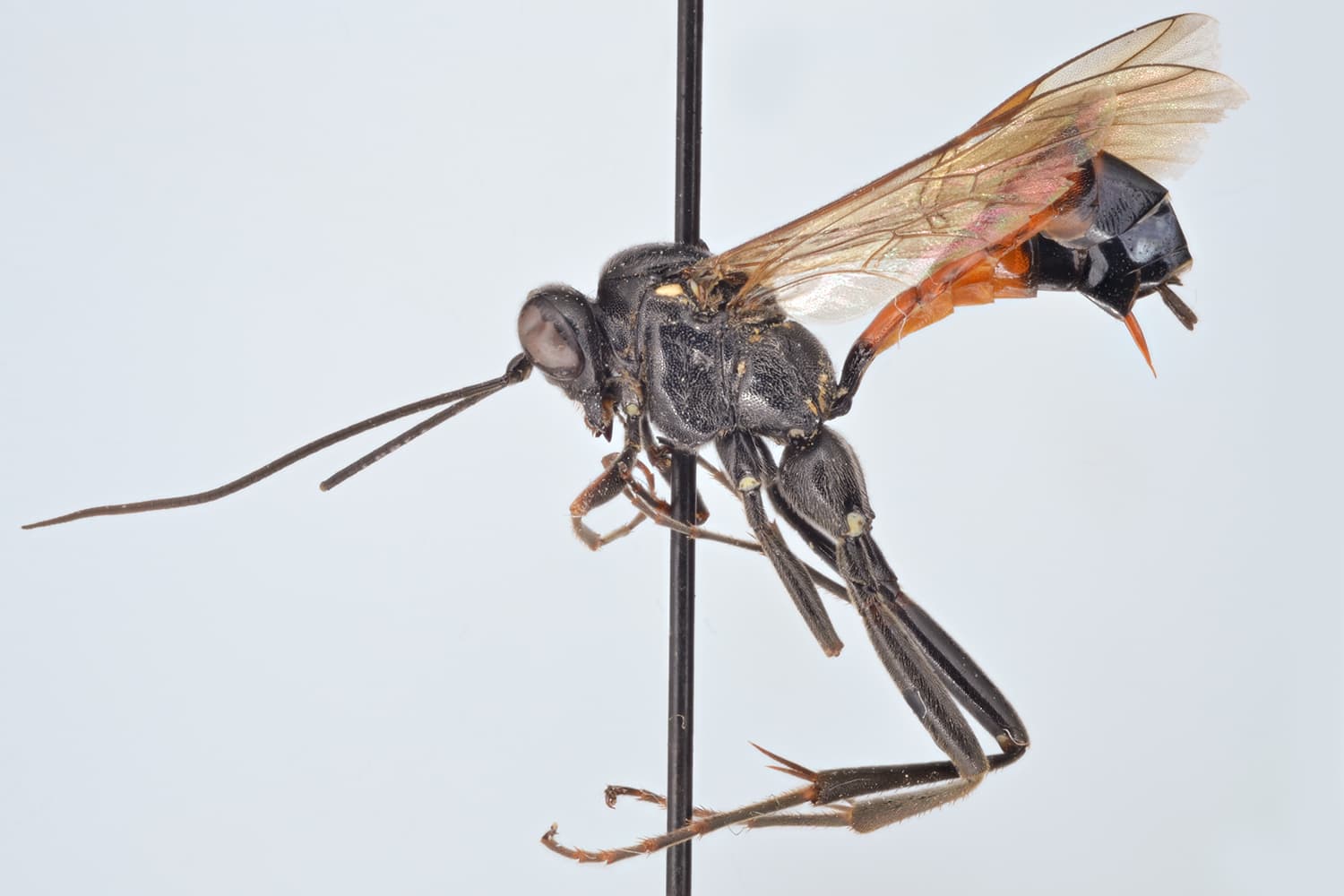
Exetastes sp.
Description
Banchinae is a species-rich subfamily containing wasps of a wide range of body shapes and sizes. Most northern European banchines are predominantly black with dark or red metasomas, though yellow patterns on the face and mesosoma are not uncommon (especially in the males). The ovipositor is always adorned with an apical notch and the claws are often pectinate, distinguishing banchines from the superficially similar (yet not closely related)
Pimplinae. The carination of the propodeum is usually greatly reduced, the strong and arched posterior transverse carina normally being the only defined carina. On the metapleuron the submetapleural carina is strongly expanded anteriorly, usually forming a wide lobe. Members of the two largest tribes, Atrophini and Glyptini, are usually slender and with long ovipositors. Banchini is defined by more robust body shapes with almost hunch-backed profiles and short ovipositors.
Biology
All banchines with hosts records are koinobiont endoparasitoids of Lepidoptera. Atrophini is the least specialized tribe with host ranging from large xylophagus cossids to noctuids or smaller moths such as tortricids or psychids. Glyptini is in contrast much more consistent, with the vast majority of reliable host records being concealed tortricids (larvae living in leaf-rolls, galls, flower-heads, etc.). Banchini appears to be similarly specialized since all known hosts are noctuids that pupate in soil. Some members of this tribe have the ability to produce strong pungent odors when stressed.
Distribution
Banchinae has a worldwide distribution with around 2000 described species.
Records from GBIF and the Bugweb collection are shown on the map.