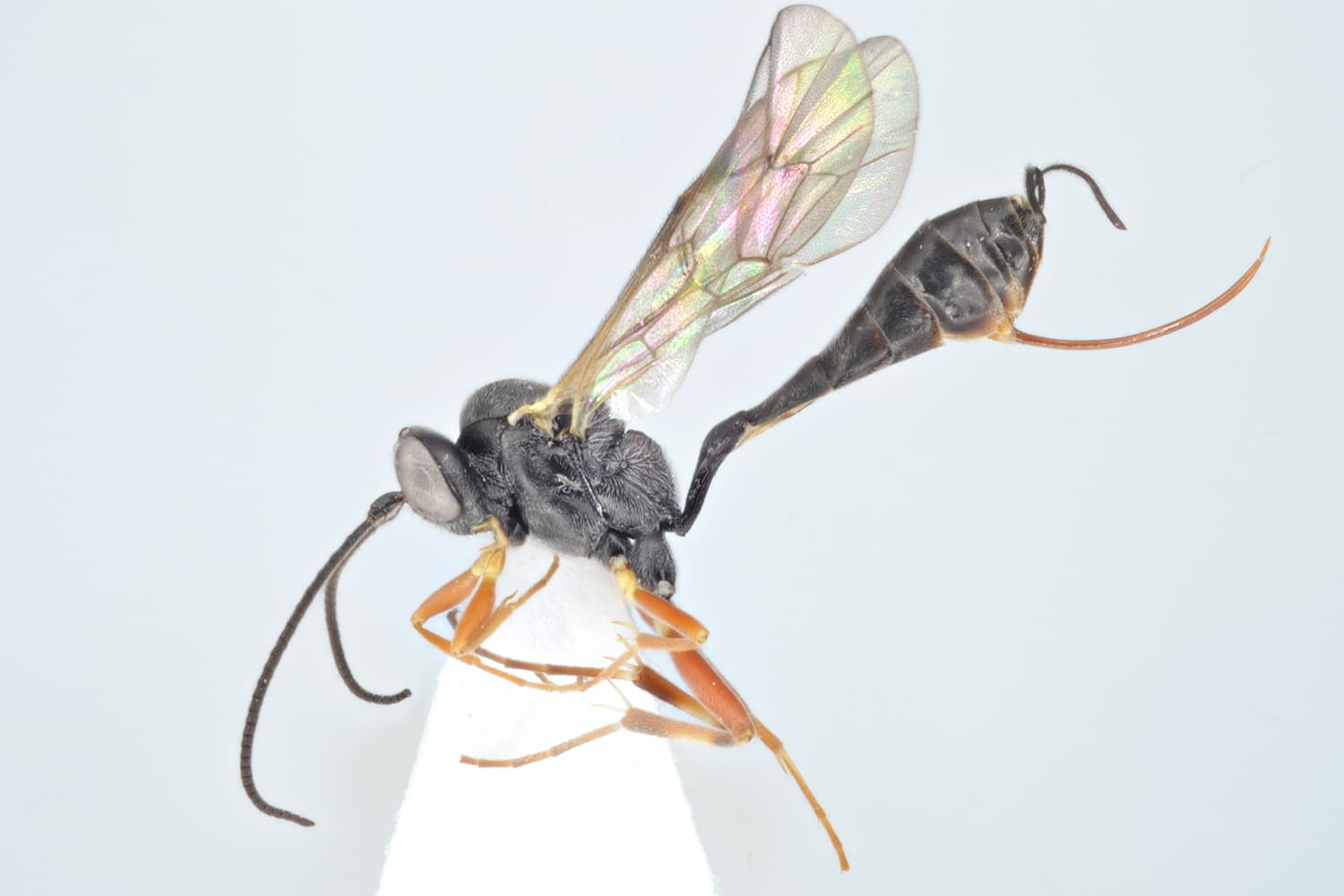
Campoletis ensator
Description
Campopleginae is a large and rather homogeneous subfamily. The metasoma is often red or yellow while the rest of the body is as a rule (with a few exceptions) completely black. The subfamily is recognized by the distinctly petiolate first metasomal segment, notched ovipositor, usually complete posterior transverse carina and single bulla on vein 2m-cu. Additional useful characters include the distinctly laterally compressed metasoma, the face usually being covered by distinct silvery setae and the often green and iridescent eyes in living specimens. The length and shape of the ovipositor vary greatly.
Campoplegines are most likely to be confused with the closely related subfamily
Cremastinae, which can be distinguished by the spurs of the hind tibia being inserted into separate sockets, a unique character among Ichneumonidae (spurs of hind tibia are inserted in the same socket in Campopleginae).
Biology
Most campoplegines are solitary koinobiont endoparasitoids of Lepidoptera, though rarer hosts include Coleoptera, Symphyta, Raphidioptera and reportedly terrestrial Trichoptera. The host is usually attacked early in its development. Most species kill their host in its larval stage, more rarely as a prepupa. Several genera that pupate outside their hosts spin distinctive cocoons, the form and color of which can be remarkably diagnostic. Overwintering usually occurs in host larvae or cocoons.
Distribution
Campopleginae is a cosmopolitan subfamily, common in both tropical and temperate regions.
Records from GBIF and the Bugweb collection are shown on the map.
Identification
An interactive key to genera can be found
here.