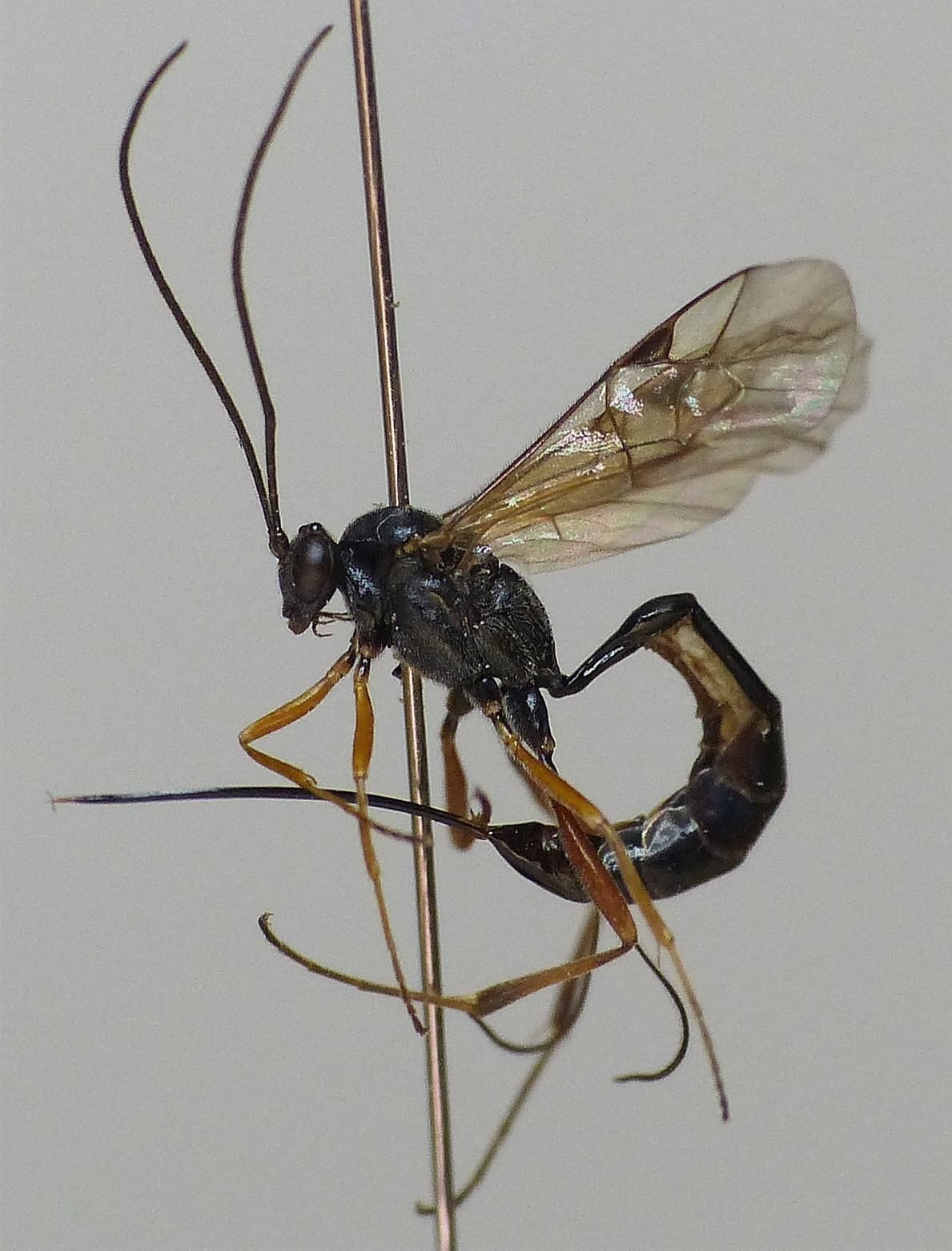
Cremastus crassicornis
Description
Cremastines are usually slender and brightly colored wasps, though exceptions exist. Most species are black with the body adorned with yellow areas to a varying degree. A completely unique character for the subfamily is that the spurs of the hind tibia are inserted in separate sockets, separated by a narrow sclerotized bridge, distinguishing it from similar subfamilies such as
Campopleginae. Additional useful characters include only one bulla on the fore wing vein 2m-cu, the often large and triangular pterostigma, longitudinal microsculpture on the metasoma and the usually laterally compressed metasoma.
Members of the common genus
Pristomerus
can be easily recognized by a large ventral tooth on the hind femur, a character not shared by any similar ichneumonids.
Biology
Cremastines are most commonly found in warm and dry habitats such as coastal areas or heathlands. All species that have been reared are solitary koinobiont endoparasitoids of Lepidoptera. They tend to specialize in weakly concealed hosts, such as larvae situated in leaf-rolls, silk webbing or fruit bodies. Some cremastines are known to be superparasitoids.
Distribution
Cremastinae has a cosmopolitan distribution, though it is more diverse in warmer regions. The bulk of the European species are found in the south.