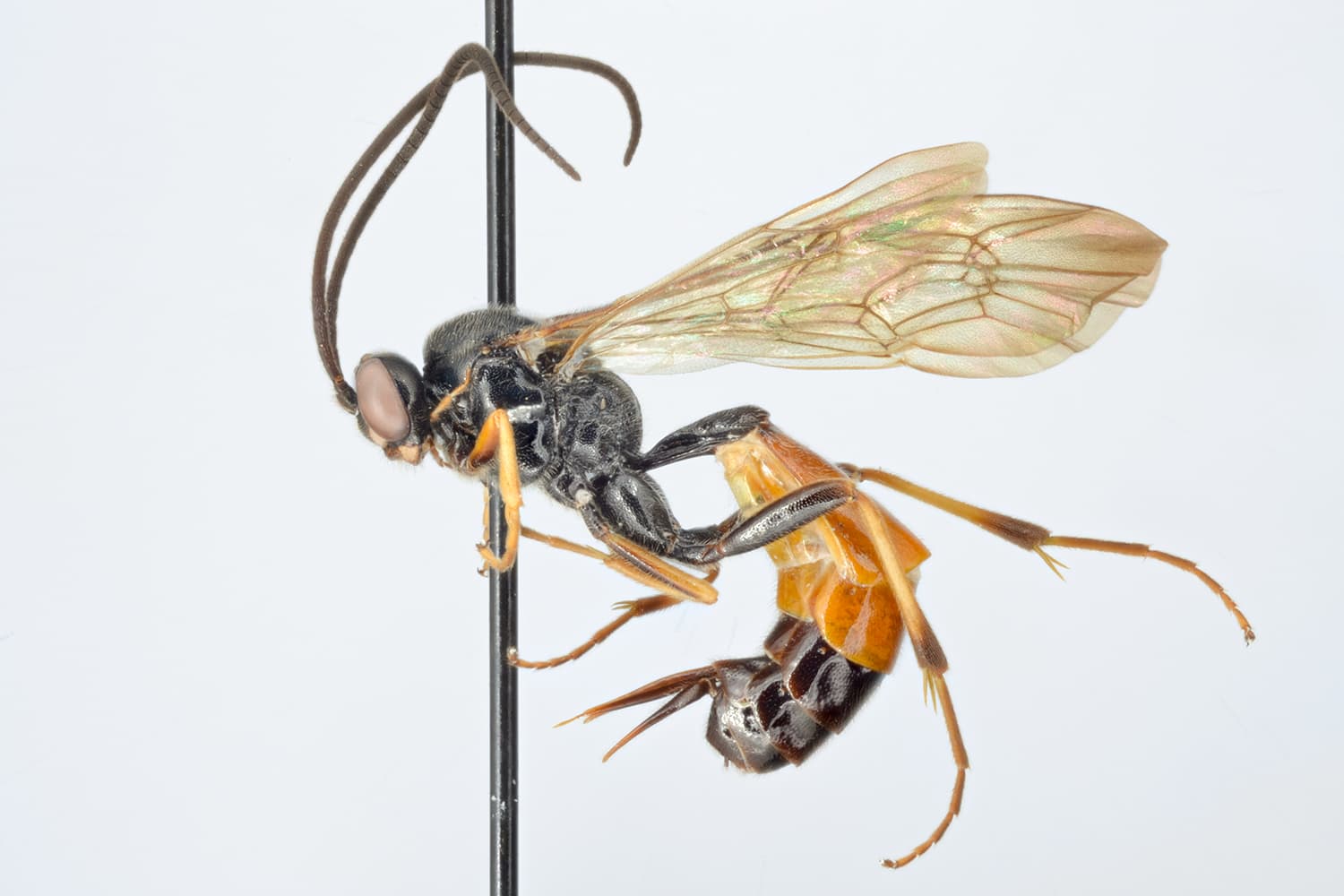
Ctenopelma luciferum
Description
Ctenopelmatinae is a large and diverse subfamily that is difficult to define morphologically. They are often recognized by the absence of characters defining other subfamilies. The shape of the first tergite varies greatly, ranging from petiolate with the spiracles clearly beyond the midpoint to broad and with the spiracles relatively close to the base. Glymmae exist in about two thirds of genera and are in the tribe Perilissini similar to what is found in
Mesochorinae
(deep and meeting in the middle, only separated by a translucent membrane). The claws are often pectinate. The wing vein 2m-cu usually has a single bulla, but few trends in wing venation exist besides this. In most cases (except in the tribe Pionini) the ovipositor has a subapical dorsal notch.
The presence of a tooth-like process on the outer apical face of the fore tibia is the most consistent character, though it can be nearly invisible in some specimens. This feature is however sometimes found in other subfamilies, including the very similar
Tryphoninae. Ctenopelmatines are best distinguished from Tryphonines by the absence of a row of long erect setae on the clypeus, a character almost all Tryphonines have.
Biology
The Ctenopelmatinae is one of the two large subfamilies parasitizing Symphyta, the other being Tryphoninae. Ctenopelmatines are koinobiont endoparasitoids of sawfly larvae, with only a few parasitoids of leaf-mining lepidoptera breaking this rule. The host range of the different tribes and genera are poorly understood, in large part due to the relative difficulty of rearing sawfly larvae.
Distribution
Ctenopelmatinae has a near global distribution but with the greatest diversity found in the northern temperate regions.
Records from GBIF and the Bugweb collection are shown on the map.
Identification
Identification of Ctenopelmatinae is notoriously difficult and determining species is often impossible with the currently available literature. Townes (1970) is likely the best key to the Palearctic genera, it is however difficult to use and based on the poorly defined tribes. An interactive key is under development
here.